KDSP II
About the Programme
The second Kenya Devolution Support Programme (II) is a World Bank funded programme which aim is to strengthen county performance in financial management coordination and accountability for resources. The programme will achieve its objectives through three Key Result Areas (KRAs) as follows.
a. Key Result Area I-(KRA-I)
Sustainable Financial and Expenditure Management.
b. Key Result Area II-(KRA-II)
Intergovernmental Coordination, Institutional Performance and Human Resource Management.
c. Key Result Area III-(KRA-III)
Oversight Participation and Accountability.
Under each Key Result Area, there are Disbursable Linked Indicators (DLIs) that the county government is required to achieve.
Disbursable linked indicator (DLI) for the County Government
DLI 2; County government has put in place programme management and implementation structures
Detailed activities that will be implemented by the county government under KDSP II are presented in the approved work plan, budget, and cash flow plan.
KDSP II Grant Mechanisms
KDSPII grants will be awarded at two levels
a. level 1 grants: institutional strengthening grant
b. level 2 grants: service delivery and investment grant
Institutional Strengthening Grant (Level 1 Grant)
Level 1 Grant is designed to support the county government to undertake core institutional reforms, finance and capacity-building activities that will strengthen its ability to access the Level 2 Grant.
As a requirement, the county government of Bungoma has included kshs 37,500,000 for the use of the Level 1 Grant in the 2024/25 budget. To access it in the first year, the county government has:
a) established the programme core governance structure, CPSC, CPTC and CPIU
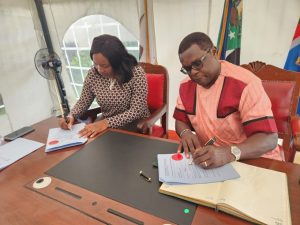
b) Signed a Participation Agreement providing for, among others, publishing of budget and expenditure data and
c) Prepared and approved work plans, cash plans, and budgets consistent with the agreed methodology and standards.
In subsequent years, counties will, in addition to (a) and (b), need to
d) attain a Qualified or unqualified audit opinion (with time-bound action plans for addressing qualifications),
e) Reports on implementation progress and use of Program funds, and
f) ensure timely release of KDSP II funds from the County Revenue Fund to the Special Purpose Account
Service Delivery and Investment Grant (Level 2 Grant)
Level 2 Grant is aimed at financing for investments in county infrastructure and service delivery. The chosen investments must be aligned with the CIDP and CADP. to access the grant, the county government will be required to have planned and budgeted for the use of the Level 2 Grant before accessing it. In addition, the county government will need to meet the following minimum conditions:
a) Has prepared a work plan and budget for use of the investment grant in the next fiscal year
b) Has disclosed stock of pending bills
c) Has disclosed OSR collection
d) Has established a county SPMU
e) Has (i) developed implementation plans for HR and skills audit.
(ii) Developed implementation plans for special payroll audits; and
(iii) Published staffing levels aligned with approved structures and staff establishment
f) Has screened proposed infrastructure investments (which will also include feasibility studies and E&S screening for proposed investments
g) Has trained gender officers aligned with approved training programs
h) Has established County Program Implementation Unit
CRITERIA FOR AWARDING LEVEL 2 GRANTS
The Level 2 Grant will be allocated based on both the achievement of the minimum conditions and the county’s scores in the performance measures. These performance measures reflect the three KRAs and the seven DLIs for the Level 2 Grant. The relative score of a county (that is, its score as compared to the score of others) will be considered to determine the size of the allocation for each DLI.
For each DLI (DLIs 3–7), 50 percent of the Level 2 Grant envelope will be divided among counties that met that respective DLI result using the CRA formula (that is, the equitable shares). The other 50 percent is allocated based on the scores against the performance measures pertaining to each respective DLI result area, weighted with the CRA formula. Therefore, meeting a DLI result will give counties access to the base allocation, which can be further enhanced by above-average performance against the related performance measures. The performance measures and scoring guidelines are provided in annex 3.
The investment grant for a county is the sum of what it is allocated under DLIs 3–7. The allocation for the Level 2 Grant is as follows:
• DLI 3: US$500,000 for each county that has increased its OSR by at least 5 percent annually, over and above the rate of inflation
• DLI 4: US$550,000 for each county that has prepared and is implementing an action plan to reduce the stock of pending bills and maintain it at minimal levels
• DLI 5: US$700,000 for each county that has integrated its HR records, authorized staff establishment and payroll, and uploaded cleaned payrolls in the HRMIS
• DLI 6: US$350,000 for each county that is enhancing accountability for results through an integrated performance management framework
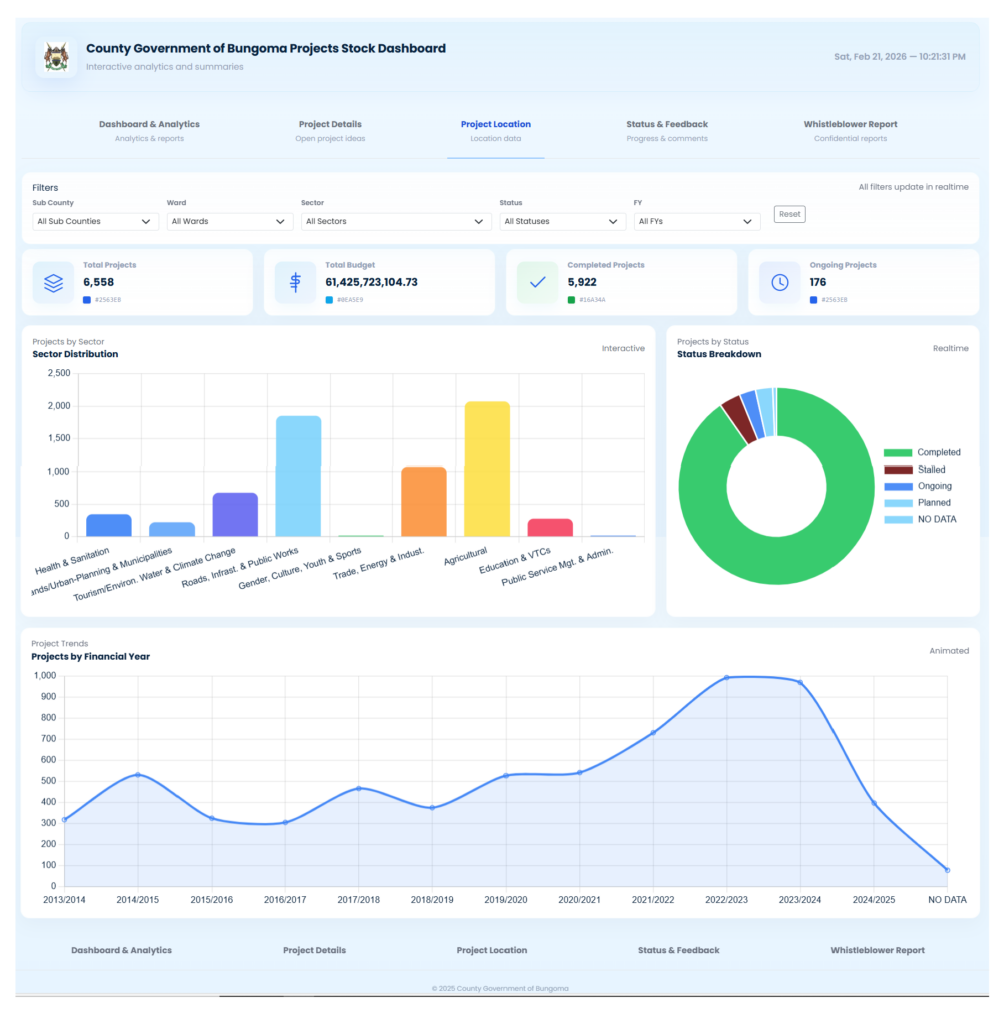
• DLI 7: US$400,000 for each county with a PIM dashboard with citizen feedback mechanisms.
County-Level Institutional Arrangements
To support the implementation of the Programme, the following institutional arrangements have been established.
a. County Program Steering Committee (CPSC)
The CPSC comprises the following members.
1. H. E Hon. Kenneth Lusaka – Governor, Chair
2. Dr. David Wanyonyi Wamamili – CECM PSMA & ICT
3. Carolyne Makali – CECM Finance & EP
4. Chairperson – County Public Service Board
5. Hon. Emmanuel Situma – Speaker – County Assembly
6. Mr. Benedict Esiromo Emacar – CECM – Gender, Youth, Culture & Sports
7. Mr. Wekesa Douglas Sasita – CECM – Trade Energy and Industrialization
8. Dr. Andrew Wekesa Wamalwa – CECM Water, Natural Resources, Environment, Tourism & Climate Change
9. Mr. William Nasong’o – County Secretary
10. Mr. Cyrus Silali Wanyonyi – County Programme Co-ordinator (ex-officio) – Secretary
b. County Program Technical Committee (CPTC)
The CPTC is responsible for the technical operation of the Program. It comprises of representation from the relevant county agencies and departments from the relevant sectors to ensure coordinated delivery of program results. This includes,
1. Mr William Nasong’o – County Secretary- Chair
2. Ms Evelyn T. Wekesa – Chief Officer, PSMA & ICT
3. Mr Robert Juma – Chief Officer, Finance & Economic Planning
4. Nicolas T.J Kiboi – Chief Officer, Environment
5. David Maling’a- Chief Officer, Social Services
6. Mr. Joseph Makata – CEO, County Public Service Board
7. Mr Charles Wafula – Clerk, County Assembly; and
8. Mr. Reuben Wambwa – Chief Officer, Trade Energy and Industrialization.
9. Mr. Cyrus Wanyonyi Silali – County Program Coordinator – Secretary.
c. County Technical Implementing Partner Teams (CTIPTs)
The CTIPTs support technical operation of the program KRAs in the county. Representatives in the CTIPTs are selected according to their technical capacity and mandates and organized and coordinated into dedicated results teams for each KRA to drive collaboration and achieve holistic results. The technical focal persons of the respective KRAs will chair the partner teams.
d. County Program Implementation Unit (CPIU)
The CPIU comprises
1. Mr. Cyrus Wanyonyi Silali – County Program Coordinator – Head of CPIU.
2. Technical focal persons on the three Program KRAs,
• Mr. Martin Mabonga – Economist – KRA I
• Mr. Joseph Kisindai – Director of Human Resource Management – KRA II
• Ms Gladys Okongo – Principle Human Resource Officer – KRA III
3. Focal persons from the SPMU (on procurement and FM),
•Ms Jacklyne Mumelo – Chief Supply Chain Management Officer
•Mr. Yahya Mutali – Finance Officer
•Ms. Zuenah Wekesa – Accountant
4. Environmental and social safeguards officers
• Mr. Brian Wamalwa – Director of Environment – Environment risk safeguard and climate change adaptation specialist.
• Ms Gladys Situma – Social Development officer – Social safeguard specialist.
5. Monitoring & Evaluation Officer
• Dr. Ipapo Emukule – Director M & E – Monitoring & evaluation specialist.
6. GRM Officer
• Ms Mercy Kisuya – Admnistrative Officer – Grievance and readdress mechanism specialist
7. Gender Officer.
• Mr. Moses Chebonya – Director of Gender – Designing and implementing a training plan for gender officers.
8. ICT Focal Person
• Mr. Thomas Wafula – CICTO
9. Communications Focal Person
• Mrs. Caro Situma – Communications Officer.
10. Programme Auditor
• Ms. Mercy Chebasa Psirimoi– Auditor
Programme Activities
The programme will achieve its objectives through three Key Result Areas (KRAs) as follows.
a. Key Result Area I-(KRA-I)
Sustainable Financial and Expenditure Management….Read more…
b. Key Result Area II-(KRA-II)
Intergovernmental Coordination, Institutional Performance and Human Resource Management.…Read more…
c. Key Result Area III-(KRA-III)
Oversight Participation and Accountability.….Read more…
Under each Key Result Area, there are Disbursable Linked Indicators (DLIs) that the county government is required to achieve.
Disbursable linked indicator (DLI) for the County Government
DLI 2; County government has put in place programme management and implementation structures
Detailed activities that will be implemented by the county government under KDSP II are presented in the approved work plan, budget, and cash flow plan.
COUNTY BUDGET DOCUMENTS
Annual Development Plan for FY24/25 ….view…
County Fiscal Strategy Paper for FY24/25…view…
Approved Program-Based Budget for FY24/25...view…
County Appropriation Act for 2024…view…
County Finance Act 2023_…view…
County Budget Review and Outlook Paper for FY24/25…view…
County Integrated Development Plan – 2023-2027…view…
Budget Implementation Report-4th Quarter Fy 2024-25…view
Budget Implementation Report-3rd Quarter Fy 2024-25…view
Budget Implementation Report-2nd Quarter Fy 2024-25…view…
Budget Implementation Report-1st Quarter Fy 2024-25…view…
Budget Implementation Report-4th Quarter Fy 2023-24…view…
Recurrent expenditure summary 24/25 and projected expenditure summary for 25/26 – 26/27 …view…
DLI 3 – Increased OSR collected by at least 5% annually over and above the rate of inflation.
Annual OSR report FY 2023-24 and FY 2024-25
OSR collected (disaggregated by revenue stream) in previous year-FY 2024-25
Revenue Analysis by Stream Report for FY 2023/24 – 2024/25.
Monthly OSR report FY 2023-24 and FY 2024-25
Kenya-Consumer-Price-Indices-and-Inflation-Rates-June-2025
a. System printout from BARMS FY 2024-25
b. BARMS reports for 1st & 2nd quarter FY 2024-25
a. Quarterly Revenue Report FY2024-25
b. Quarterly Revenue Report FY2023-24
County Revenue Mobilization Strategy FY2025-26/Policy/Plan
OSR Revenue policy/laws/ regulations
a. The Bungoma County Agricultural Produce Cess Act, 2017.
b. The Bungoma County Alcoholic Drinks Control Act, 2015
c. The Bungoma County Parking Management Act, 2017
d. The Bungoma County Parking Management Act, 2017
e. The Bungoma County Public Markets (Amendment) Act, 2023
f. The Bungoma County Revenue Administration Amendment Act, 2023
County Internal Audit OSR report and implementing plan.
Bungoma County Government Revenue Enhancement Action Plan
DLI 4 – Prepared and implemented action plans to reduce stock of pending bills and maintain at minimum levels
Pending Bills Universe JUNE2025
Pending Bills Universe JUNE2024
Updated-Stock-Pending-bills-Q4-FY2024-25
Pending bill Action plan for the FY 2024/25
Quarterly reports on the status of pending bills
DLI 5 – Integrated HR records, authorized staff establishment and payroll, and uploaded cleaned payrolls in the HRIS-KE
Approved organizational structure and authorized staff establishment.
HR audit Report and the action plans.
OAG special payroll audit report (2025) and the action plans
HRIS-Ke system generated HR and payroll report
Reports on implementation of SRC circulars & M&E reports recommendations
DLI 6 – Enhancing accountability for results through an integrated performance management framework
Vetted and Signed Performance Contracts
DLI 7 – Participating counties that have established public investment management (PIM) dashboards with citizen feedback mechanisms
Project Concept Note
Pre-feasibility Study Report
Approved Project screening Report on Climate, Disaster, Environmental, and social risks
Project Dashboard with a citizen feedback mechanism-CGB-PIMS
A project stock-take report
Project stock-take implementation Plan
Appointment letters of community-led PMCs
Minutes/reports of community-led project management committee meetings